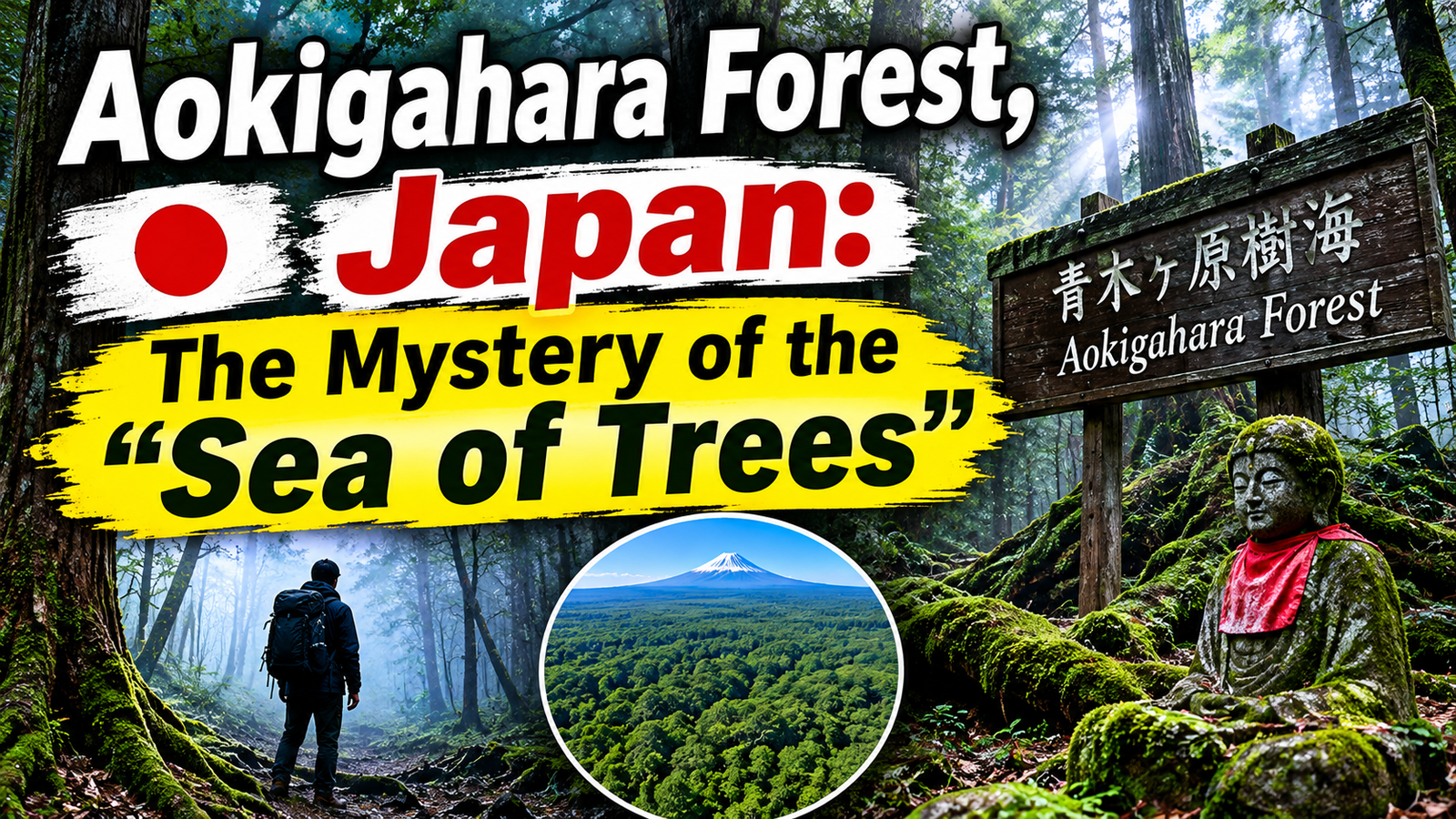
The eerie forest at the foot of Mount Fuji, and the truth behind the legends that surround it.
Step off the road at the base of Mount Fuji and walk a few minutes into the trees, and the world changes. The wind drops. The sounds of traffic vanish. Every direction looks the same: twisted roots, green moss, and dark trunks that seem to go on forever.
This is Aokigahara, known in Japan as Jukai, the “Sea of Trees.” It is one of the most photographed, most feared, and most misunderstood forests on Earth. Some call it haunted. Others call it a natural wonder. The truth is a mix of volcanic science, ancient folklore, and human sadness.
Where Is Aokigahara and How Did It Form?
Aokigahara lies at the northwest base of Mount Fuji, in Yamanashi Prefecture, about 100 km from Tokyo. It covers roughly 30 square kilometers.
The forest is surprisingly young. It grew on lava from the massive Jogan eruption of 864 AD, which flowed down Fuji’s slope and buried the land below. Over more than a thousand years, trees slowly took root on that hardened rock. Because the volcanic soil is thin and rocky, the roots cannot dig deep. Instead they spread across the surface, twisting over stone in tangled, snake-like patterns. This is a big part of why the forest looks so strange.
Why Does It Feel So Silent?
Many visitors say Aokigahara feels unnaturally quiet. There is a scientific reason. The dense canopy blocks wind, and the uneven, porous volcanic rock is said to absorb sound. Combined with the lack of large animals, the forest can feel like a room with the volume turned down.
The ground is also full of lava caves and ice caves, including Narusawa Ice Cave and Fugaku Wind Cave. These are popular with tourists and are among the forest’s real, documented attractions.
Do Compasses Really Go Crazy Here?
A popular claim says that magnetic iron in the lava makes compasses spin. It is often repeated online, but it is exaggerated. Local rock can cause small deviations in some spots, but modern GPS and phones generally work fine in most areas. The real danger is simpler: the forest is a maze of near-identical trees and uneven rock, so it is easy to lose your sense of direction. That is why visitors are urged to stay on marked trails and why hikers use tape to mark their path.
Folklore and Japanese Ghost Stories
Japanese tradition has long held that restless spirits, called yurei, can linger in places marked by sorrow. Aokigahara is often linked to these tales, and local people have long treated the forest with respect and caution.
One legend connects the forest to ubasute, a practice said to have occurred in times of famine, when families abandoned elderly relatives in remote places. Historians are unsure this ever happened at Aokigahara, and there is little solid evidence for it. It remains a story rather than a proven fact.
How Did Its Dark Reputation Grow?
Much of the forest’s modern fame comes from books, films, and the media. In 1960, author Seicho Matsumoto published the novel Nami no Tō (“Tower of Waves”), whose ending takes place in Aokigahara. Many writers credit it with fixing the forest’s image in the public mind, though that link is debated.
Later, documentaries, internet articles, and horror films spread the idea of a cursed place. In 2017, a viral video by a well-known YouTuber filmed inside the forest drew worldwide criticism for being disrespectful, and the incident brought fresh attention to how the forest is portrayed.
It is important to be honest here: Aokigahara is also known as a place where people in deep emotional pain have come to end their lives. Local authorities treat this as a serious public health issue, not a ghost story. Signs along the entrances urge visitors to think of their families and to seek help, and police and volunteers patrol the area. Japan has also made major efforts in recent decades to improve mental health support, and national suicide rates have fallen from their peak. A responsible account of Aokigahara must remember that real people and real families are part of this story.
Nature, Wildlife, and Beauty
Behind the dark reputation, Aokigahara is a living ecosystem. Dense stands of hemlock and cypress grow here, and moss covers nearly every rock and root. Birds, small mammals, and insects live under the canopy. Parts of the area are part of the Fuji-Hakone-Izu National Park, and Mount Fuji itself was named a UNESCO World Heritage Site in 2013 as a cultural landscape.
Many people visit simply to hike, photograph the moss-covered lava, and explore the caves. Guided tours with trained local guides are available and are the safest way to experience the forest.
Is It Dangerous to Visit?
For prepared visitors, Aokigahara is not especially dangerous. The real risks are practical ones: getting lost, twisting an ankle on uneven rock, or being caught by weather. If you plan to visit:
Stay on marked trails and never wander off alone.
Go with a licensed guide if you want to explore deeper.
Carry water, a charged phone, and a map.
Be respectful. Do not film for shock value or disturb anything you find.
Final Verdict: Haunted or Misunderstood?
Is Aokigahara a haunted forest? There is no scientific evidence of ghosts. What exists instead is a powerful mix: a landscape shaped by a volcano, a silence created by nature, centuries of folklore, and a sad human history that deserves compassion rather than sensationalism.
That is what makes the Sea of Trees so memorable. It reminds us that the most haunting places are often the ones where nature, memory, and human feeling meet.
If you or someone you know is struggling with difficult thoughts, please reach out to a trusted person or a local mental health helpline. You are not alone, and help is available.
What do you think? Is Aokigahara a place of mystery, or simply a beautiful forest with a heavy past? Share your thoughts in the comments below.
