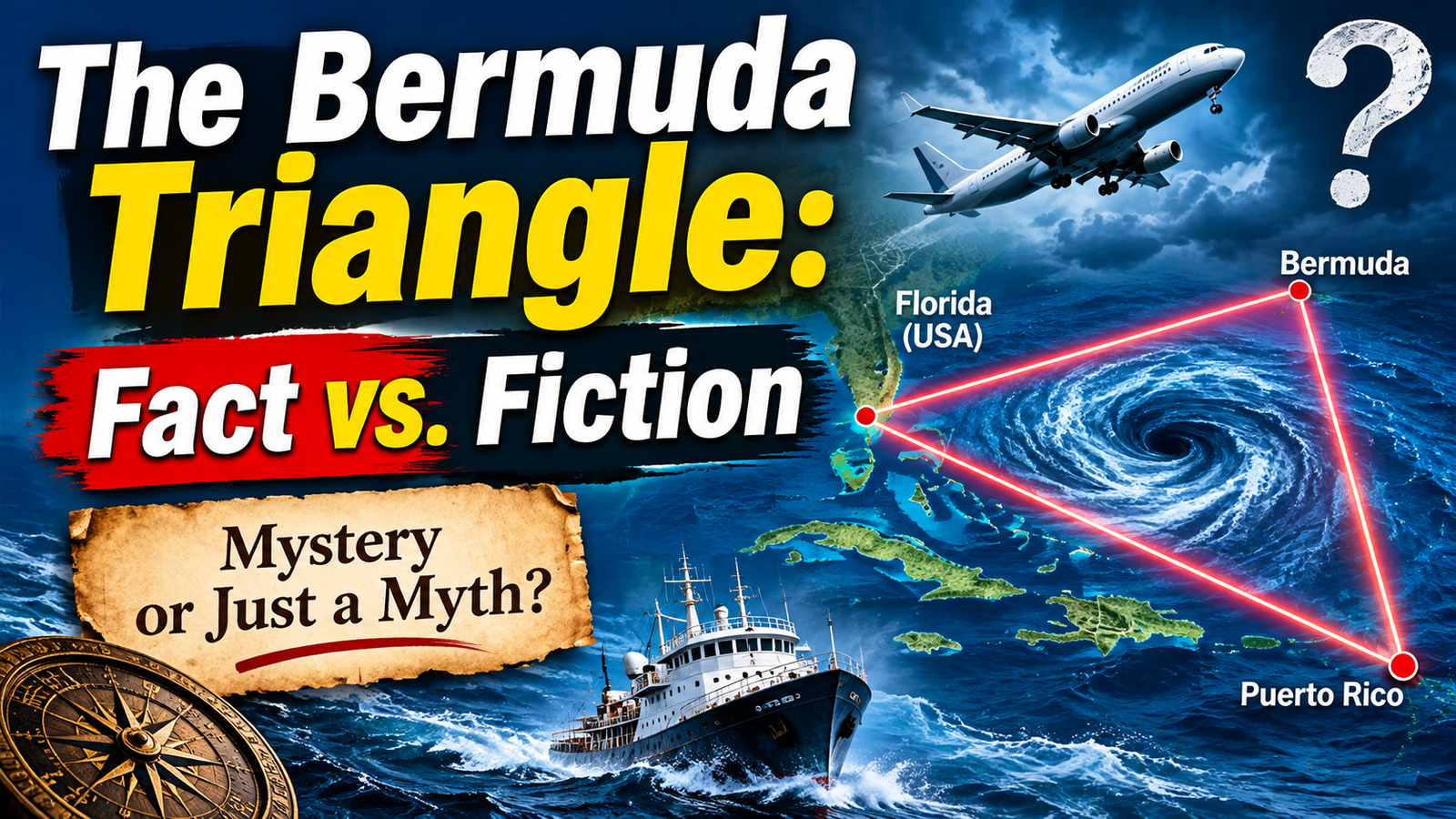
Why do ships and planes seem to vanish here, and what does science actually say?
Picture a calm, sunlit afternoon in December 1945. Five U.S. Navy bombers take off from Fort Lauderdale, Florida, on a routine training flight. A few hours later, their radio chatter turns confused and frightened. The pilots say their compasses are spinning and that nothing looks right. Then the voices fade, and the planes are never seen again.
That story, more than any other, made the Bermuda Triangle famous. Yet the real story is far more interesting than the legend. It involves stormy seas, human error, a clever magazine writer, and a surprising amount of exaggeration. Let’s separate what really happened from what people have added over the decades.
Where Exactly Is the Bermuda Triangle?
The Bermuda Triangle, sometimes called the Devil’s Triangle, is a loosely defined area of the western North Atlantic Ocean. Most versions draw its corners at Miami (Florida), the island of Bermuda, and San Juan (Puerto Rico), covering roughly 500,000 square miles of open water.
Here is something that surprises many people: the Bermuda Triangle is not an official geographic region. The U.S. Board on Geographic Names does not recognize it, and the borders change depending on who is telling the story. When the boundaries can move, almost any disappearance in the wider region can be counted as a “Triangle mystery.”
Where Did the Legend Come From?
Ships have vanished at sea for as long as people have sailed, but the idea of a cursed triangle is surprisingly recent. The first known mention came in 1950, when journalist E.V.W. Jones wrote an Associated Press article about unexplained disappearances in the area. In 1952, Fate magazine published a piece by George X. Sand about Flight 19 and other losses. The name itself came in 1964, when writer Vincent Gaddis published “The Deadly Bermuda Triangle” in Argosy magazine.
Then, in 1974, author Charles Berlitz released The Bermuda Triangle, which sold millions of copies. Berlitz suggested explanations ranging from lost Atlantis technology to alien abduction, and the Triangle became a household name.
The Most Famous Disappearances
Flight 19 (December 5, 1945)
Five TBM Avenger torpedo bombers, with 14 airmen, left Naval Air Station Fort Lauderdale on a navigation training exercise. The flight leader, Lieutenant Charles Taylor, was an experienced pilot. About 90 minutes in, he reported that his compasses were malfunctioning and that he was unsure of his position.
Taylor believed he was over the Florida Keys, though he was likely somewhere else. He led the group away from land and out over the Atlantic. As night fell, the weather worsened and seas grew rough. Fuel ran low, and the planes ditched in the ocean.
A rescue seaplane, a PBM Mariner with 13 crew members, was sent to search and also disappeared. A ship in the area reported seeing a large explosion. PBM Mariners had a known reputation for fuel vapor problems, which makes an accidental explosion a very plausible explanation. The Navy’s investigation blamed the loss on Taylor’s confusion, but a line saying the cause was unknown was later reworded into the dramatic claim that the planes had flown off “to Mars.”
USS Cyclops (March 1918)
The USS Cyclops, a massive Navy cargo ship, left Barbados in March 1918 carrying a heavy load of manganese ore. She vanished with around 306 people on board, one of the largest non-combat losses of life in U.S. Navy history. No distress call was ever received. Investigators later found that the ship had mechanical issues and was overloaded. Her sister ships also later disappeared in similar circumstances, which points to a structural design weakness. It is not a story of ghosts. It is a story of an overworked ship caught in a storm.
Star Tiger and Star Ariel (1948 and 1949)
Two British South American Airways passenger planes, Star Tiger in January 1948 and Star Ariel in January 1949, vanished in the region about a year apart. Both were Avro Tudor aircraft, a type with known reliability concerns. Official investigations could not determine the exact cause, but pointed to the planes’ technical limits, long overwater flights, and unpredictable weather. In those years, instruments, navigation, and radio systems were far less dependable than today.
The Carroll A. Deering (1921)
In January 1921, this five-masted schooner was found aground on Diamond Shoals off North Carolina, with sails set and no crew. It sounds like a ghost story, but the ship was found outside the Triangle’s usual boundaries, and the crew’s disappearance happened in a period when piracy and rum-running were active along the coast.
Why the Mystery Feels Bigger Than It Is
Researcher Lawrence David Kusche, a librarian at Arizona State University, spent years checking the original records behind the Triangle’s most famous cases. His 1975 book, The Bermuda Triangle Mystery: Solved, found a repeating pattern:
Weather was left out. Several “calm sea” disappearances happened during storms, which dramatic retellings skipped.
Some events happened elsewhere. A few cases occurred thousands of miles from the Triangle.
Some vessels were never lost or could not be verified. A few listed victims were later found to be fine.
Details were added or changed. Small embellishments, repeated by one author after another, slowly turned into “facts.”
In other words, the mystery was partly manufactured by the way it was retold.
What Do the Official Records Say?
If the Bermuda Triangle were truly dangerous, you would expect insurance companies to charge extra for ships passing through. Lloyd’s of London has reportedly said it does not treat the area as especially risky. The U.S. Coast Guard, which patrols these waters heavily, has stated that it sees no evidence of unusual losses compared with other busy ocean regions. The U.S. Navy and NOAA take the same view.
The reason is simple: the area is one of the busiest shipping and flying corridors on Earth. It sits between the U.S. East Coast, the Caribbean, and Europe. More traffic means more accidents, and the Triangle’s loss rate is in line with other crowded ocean zones.
Scientific Explanations
- Violent and Sudden Weather
The region regularly produces tropical storms and hurricanes. Small, fast-developing thunderstorms can appear with little warning, bringing strong winds and heavy seas. For older vessels without modern forecasting, this was a serious hazard.
- The Gulf Stream
This powerful current flows through the area and can carry wreckage far from where a ship went down. It makes searches harder and erases evidence quickly, which helps explain why debris was so rarely found.
- Rogue Waves
Once thought to be a sailor’s tall tale, rogue waves are now scientifically confirmed. These enormous, unexpected waves can reach 25 meters or more. Satellite studies in the early 2000s suggested they are far more common than once believed. A sudden wall of water could swamp a small boat in moments.
- Methane Hydrates
Methane hydrates are ice-like deposits on the seafloor that hold large amounts of trapped gas. In theory, a sudden release could make the water above less dense and sink a ship. Evidence of ancient eruptions exists elsewhere, such as the Barents Sea, but there is no solid proof it has sunk ships in the Triangle, and many researchers consider it unlikely.
- Compass Variation
Compasses point toward magnetic north, not true north. The difference, called magnetic declination, exists in many places, and trained navigators know how to compensate. Still, a pilot who was already disoriented could make a serious mistake.
- Human Error
This is the least exciting answer, and often the most accurate. Fatigue, poor judgment, bad maintenance, overloaded vessels, and navigation mistakes cause most accidents at sea and in the air. Add stress and bad weather, and small mistakes become fatal.
The Supernatural Theories
Lost Atlantis technology: Some writers claim crystals from Atlantis still produce energy beneath the sea. There is no archaeological evidence for this.
Alien abduction: Some say extraterrestrials use the area as a gateway. No credible evidence supports this.
Time warps and portals: Physics does not support the idea of holes in space-time here.
Sea monsters: Modern oceanography has found nothing of the kind.
These theories remain popular because they are fun, and stories about the unknown are part of what makes humans curious. But fun and true are not the same thing.
Why We Still Love the Bermuda Triangle
Part of the answer is human psychology. We are wired to look for patterns, especially frightening ones. When a plane disappears over open water, it feels more mysterious than a crash on land, because there is often no wreckage and no survivors.
Another reason is storytelling. Books, documentaries, and movies keep the legend alive, and a tale about a cursed ocean triangle simply sells better than a report on weather and navigation errors. And the ocean really is vast and mysterious: we have mapped more of the surface of Mars than of our own seafloor.
Final Verdict: Mystery or Myth?
Is the Bermuda Triangle truly a place where the laws of nature break down? The evidence says no. Heavy traffic, unpredictable weather, strong currents, and difficult search conditions explain most of the disappearances without anything supernatural. Many of the legendary stories were exaggerated, poorly researched, or missing key details.
But that doesn’t make the Triangle boring. It is a perfect case study in how a legend is born, how a few real tragedies can grow into a global myth, and why it is important to check the facts behind a good story. The ocean still holds secrets, and perhaps that’s why we keep looking toward the horizon.
What do you think? Is the Bermuda Triangle just a natural danger zone, or is something stranger happening out there? Share your thoughts in the comments below.
