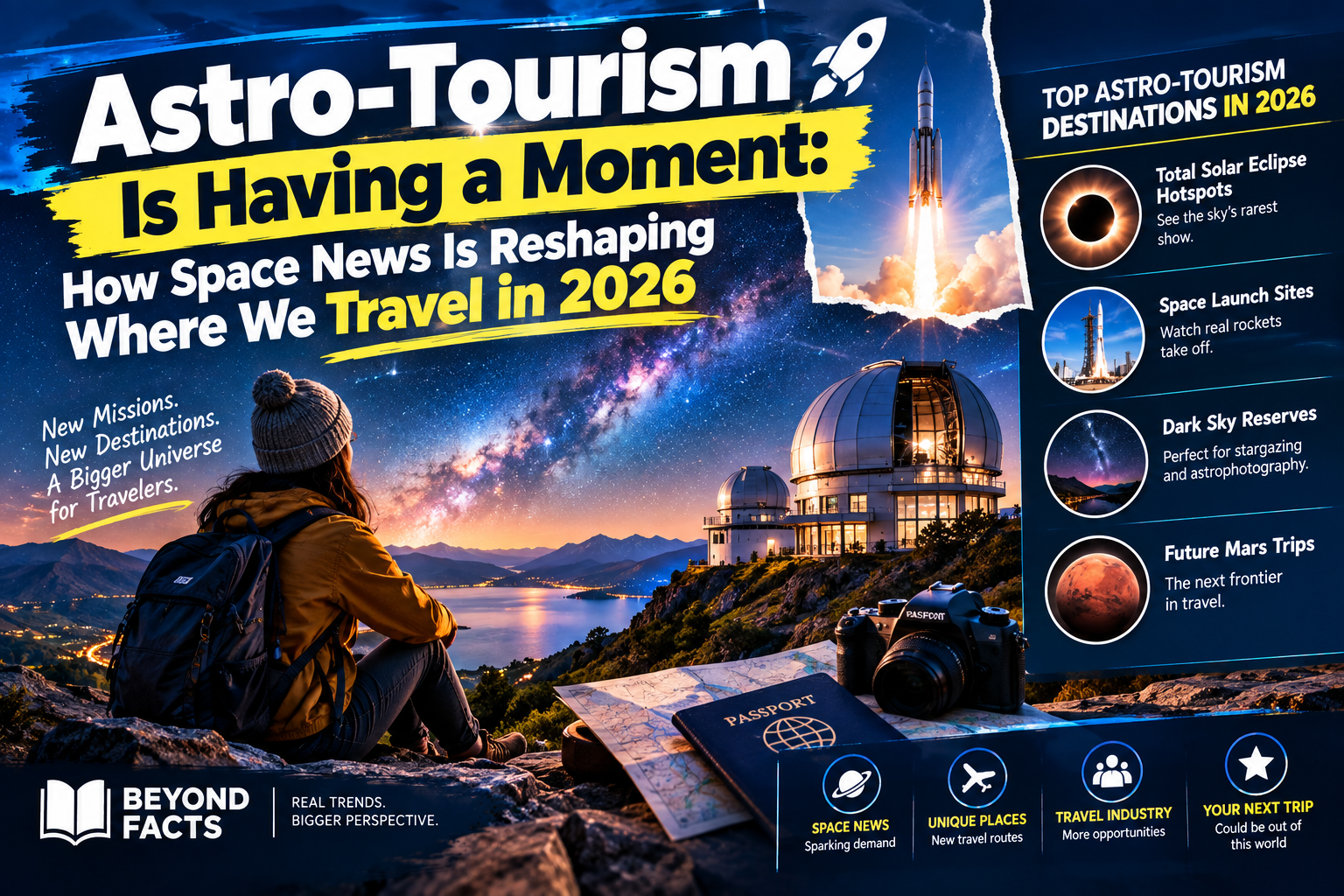
Travel trend lists usually cycle through the same ideas — sustainability, digital nomad visas, slow travel. But 2026 has produced a genuinely new one: astro-tourism, where the destination isn’t a place so much as a moment in the sky. Between a record-breaking NASA mission and a rare total solar eclipse, this has quietly become one of the most talked-about ways people are planning trips this year.
A Year Built for Looking Up
Two space events did more to fuel this trend than any marketing campaign could have:
NASA’s Artemis II mission. In April, astronauts Reid Wiseman, Victor Glover, Christina Koch, and Jeremy Hansen flew around the Moon aboard the Orion capsule “Integrity” — the first crewed lunar mission in over 50 years — before a flawless Pacific splashdown off San Diego. NASA leadership called the landing a “perfect bullseye,” and the mission proved that Orion’s heat shield, parachutes, and life-support systems could handle real deep-space conditions with a crew aboard, not just in simulations. Public interest in the Kennedy Space Center launch, and in NASA’s live coverage generally, spiked around the mission — the kind of moment that sends people searching for the next chance to see something similarly rare in person.
The August total solar eclipse. Weeks later, a total solar eclipse swept across parts of the globe, giving millions of people their first (or best) view of totality in years. Tour operators reported eclipse-chasing trips selling out well in advance, with demand strong enough that some are already doubling capacity for the next eclipse in 2027.
Put those two together and you get a travel niche that didn’t really exist five years ago at this scale: people organizing entire trips around a rocket launch, a night sky, or a few minutes of astronomical alignment.
Where Astro-Tourism Actually Takes You
The draw of astro-tourism isn’t just eclipses — it’s dark skies generally. Some of the most sought-after stargazing destinations right now include Chile’s Atacama Desert, New Zealand’s Aoraki Mackenzie Dark Sky Reserve, and Arizona, though Utah has quietly become a hub in its own right — it’s home to more certified International Dark Sky Parks than anywhere else in the world.
For travelers who want the “watch history happen” version rather than the stargazing version, Kennedy Space Center in Florida remains the obvious pilgrimage site, especially with Artemis III — the mission aiming to land astronauts back on the lunar surface — now on the horizon.
Why This Trend Has Staying Power
Astro-tourism fits neatly into a broader shift travel researchers have been tracking for 2026: travelers increasingly want depth over speed and experiences that feel meaningful rather than checklist stops. A total eclipse or a crewed lunar mission is close to the opposite of an overcrowded tourist landmark — it’s unrepeatable, time-bound, and genuinely rare, which is exactly what’s driving bookings.
It also happens to reward planning far in advance, since eclipse paths and launch windows don’t move to accommodate your schedule — something worth keeping in mind if any of this has you thinking about booking a trip around the next one.
Planning Your Own Astro-Trip
- Track the calendar first, then the destination. Eclipse paths and launch windows are fixed — build your trip around the date, not the other way around.
- Book accommodations early. Towns along eclipse paths and near launch sites routinely sell out lodging a year or more ahead.
- Have a backup viewing plan. Weather and launch scrubs are common; flexible dates or a wider viewing radius save a lot of disappointment.
- Check Dark Sky certification if stargazing is the goal. Certified parks guarantee minimal light pollution — not every “great view” destination actually delivers one.
Bottom Line
Astro-tourism isn’t a passing headline — it’s what happens when a genuinely historic year in spaceflight collides with travelers who are actively looking for experiences money can’t recreate on demand. With Artemis III and the next eclipse cycle both on the calendar, this is a trend worth watching well past 2026.