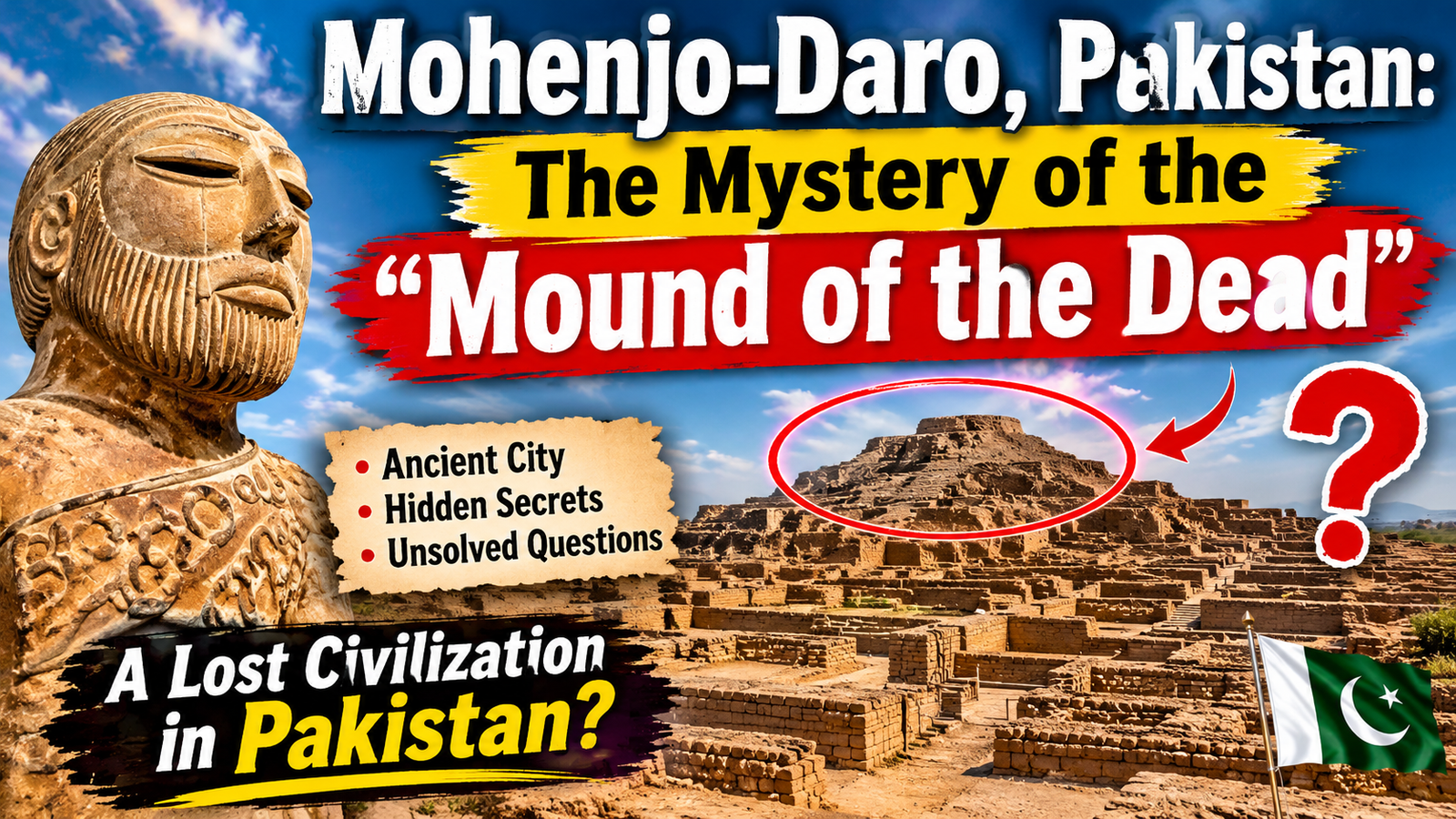
One of the world’s oldest planned cities, and the puzzle of why its people disappeared.
Long before Rome, before Athens, and even before the great Egyptian pyramids were finished, a city stood on the banks of the Indus River in what is now Pakistan. It had straight streets, brick houses, covered drains, and public baths. Tens of thousands of people lived there, trading goods across vast distances.
Then, around 4,000 years ago, the city was abandoned and slowly buried under dust. Its name was forgotten. Today we call it Mohenjo-Daro, a Sindhi phrase often translated as the “Mound of the Dead.” How did such an advanced city vanish, and what happened to its people?
Where Is Mohenjo-Daro?
Mohenjo-Daro lies in the Larkana District of Sindh, Pakistan, near the right bank of the Indus River. It was one of the largest cities of the Indus Valley Civilization (also called the Harappan Civilization), which flourished across modern Pakistan and northwest India from about 2600 to 1900 BCE. Its sister city, Harappa, lies in Punjab.
The site was rediscovered in the early 20th century. Archaeologist R. D. Banerji began excavations in 1922, and the work was later continued by John Marshall and others. In 1980, UNESCO listed Mohenjo-Daro as a World Heritage Site.
A City Ahead of Its Time
What astonishes archaeologists is how well planned the city was. Estimates suggest it was home to somewhere between 20,000 and 40,000 people, which made it one of the largest cities of its time.
Grid-pattern streets: Roads were laid out in neat blocks, much like a modern city.
Standardized bricks: Buildings were made of baked bricks of consistent size.
Advanced drainage: Houses had bathrooms, and waste water flowed through covered drains along the streets. This was remarkably advanced for 4,500 years ago.
Wells: Hundreds of wells provided clean water throughout the city.
Two main sections: A raised area, often called the Citadel, and a larger Lower Town where most people lived.
The Great Bath
The most famous structure is the Great Bath, a large brick pool about 12 meters long, 7 meters wide, and around 2.4 meters deep, with steps leading down on both sides. Its floor and walls were made watertight using bitumen, a natural tar. Archaeologists believe it was used for ritual bathing or ceremonies, though no one knows for sure.
Treasures and Everyday Life
Excavations uncovered pottery, jewelry, tools, toys, and thousands of carved seals. Two famous objects are:
The “Dancing Girl”: A small bronze statue, around 10 centimeters tall, showing a confident young woman with bangles on her arm.
The “Priest-King”: A carved stone bust of a bearded man wearing a patterned robe and headband.
The seals often show animals such as bulls and unicorn-like creatures, and carry short lines of writing in the Indus script. This script has never been deciphered. Until it is, we cannot read the city’s own voice, and a lot of its story stays silent.
A Surprisingly Peaceful City?
Unlike many ancient cities, Mohenjo-Daro shows few signs of a large army or of constant warfare. There are no obvious palaces, no giant royal tombs, and very few weapons. This has led some scholars to suggest the society was organized in a relatively peaceful, trade-based way. However, we still do not know who ruled it or how its government worked, so this idea is still debated.
What Happened to Mohenjo-Daro?
This is the biggest mystery. Around 1900 BCE, the people gradually left, and the city declined. Several theories have been offered.
- The invasion theory (now widely rejected)
In the 20th century, some scholars suggested that invaders destroyed the city. This idea was supported by a handful of skeletons found in the upper levels. Later studies showed that the skeletons came from different periods and were not evidence of a single massacre, and most researchers now reject the invasion theory.
- Climate change
Many scientists believe that a change in the monsoon pattern and a long dry period weakened the farming that supported the cities. Evidence of a global dry spell around 2200 BCE has been linked to the decline of several civilizations at the time.
- Changing rivers and floods
The Indus is a powerful, shifting river. Floods may have damaged the city repeatedly, and changes in the river’s course, or the drying of other rivers in the region, may have cut off water and trade.
- Decline in trade
The Indus cities traded with Mesopotamia and the Gulf region. If trade routes collapsed, the economy could have weakened, leading people to leave for smaller villages elsewhere.
- Disease and gradual decline
Some suggest disease, soil exhaustion, or a mix of problems played a role. Most experts now think there was no single cause. The civilization probably faded slowly over generations as several pressures combined.
The Nuclear War Myth
You may find claims online that Mohenjo-Daro was destroyed by an ancient atomic explosion, with radioactive skeletons and melted glass found in the streets. These stories come from fringe books and have no scientific support. Archaeologists have found no evidence of radiation or a sudden blast. It is best to mention this myth, and then explain why it is false, so readers are not misled.
Is Mohenjo-Daro in Danger?
Yes. The ruins are made of mud and baked brick, and they face serious threats. Rising groundwater brings salts to the surface, which crystallize and slowly crumble the bricks. Heavy rains and floods, including the major flooding in Pakistan in recent years, have caused further damage. Conservation experts and UNESCO have worked on drainage and preservation projects for decades, but the site needs constant care and funding.
Much of the site is also still unexcavated. Many experts believe that leaving parts buried is the best way to protect them until better preservation methods exist.
Visiting Mohenjo-Daro
The site is open to visitors, and there is a small museum with artifacts. A few tips:
Go in the cooler months (roughly November to February). Summers in Sindh are extremely hot.
Bring water, a hat, and sun protection. There is little shade.
Hire a local guide to understand the layout of the streets and buildings.
Do not climb on or remove any bricks. They are fragile and priceless.
Check the latest travel and safety guidance before you plan a trip.
Final Verdict: A Lost City, Not a Lost Secret
Mohenjo-Daro is not a story of aliens or lost technology. It is a story of a real, talented people who built a clean, orderly, and sophisticated city thousands of years ago, and who faced changes in their environment that they could not overcome. What makes it a mystery is the silence: an unread script, unknown rulers, and a slow disappearance.
For Pakistan, it is also a source of pride, a reminder that the land along the Indus was home to one of the greatest civilizations of the ancient world. The mound may be called the “Mound of the Dead,” but the story of its people is still very much alive.
What do you think? Do you think we will ever decipher the Indus script and finally learn what happened? Share your thoughts in the comments below.
