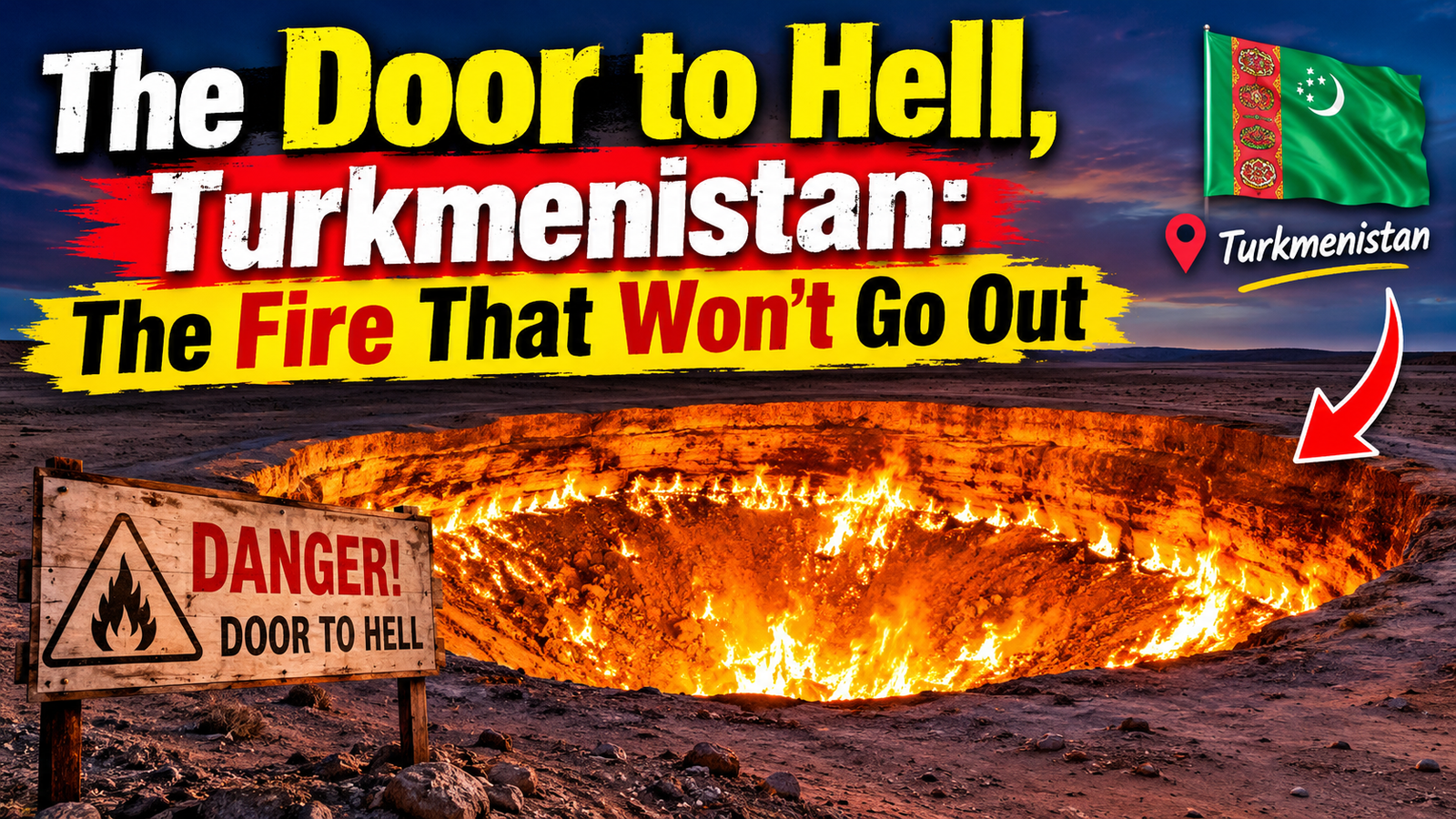
A burning crater in the middle of the desert that has been glowing for around half a century.
Imagine driving for hours across an empty desert, with nothing but sand, scrub, and a darkening sky. Then, in the distance, a strange orange glow appears on the horizon. As you get closer, you feel the heat on your face long before you reach the edge. Below you, a massive pit roars with flames, as if the ground itself has opened up.
This is the Darvaza Gas Crater, better known around the world as the “Door to Hell.” It is one of the most dramatic sights on the planet, and its story is a lot more human than supernatural.
Where Is the Door to Hell?
The crater lies in the Karakum Desert of Turkmenistan, in Central Asia, near the small village of Darvaza (also spelled Derweze). It is about 260 km (160 miles) north of the capital, Ashgabat. The desert covers most of the country, and the region is rich in natural gas.
The crater is roughly 70 meters (230 feet) wide and about 20 to 30 meters deep. At night, its glow can be seen from miles away.
How Did It Begin?
The most widely told version of the story goes back to 1971, during the Soviet era. Geologists were drilling in the area, looking for oil and gas. They hit a large underground cavern filled with natural gas. The ground above it collapsed, and the drilling rig and equipment fell into a huge hole.
The crater began leaking methane, a gas that is dangerous to people and animals. Fearing it would spread, engineers decided to set it on fire. They expected the fuel to burn off within a few days or weeks.
It did not. The fire kept burning, and it has been burning ever since. That is the reason it is often described as burning for about 50 years.
A note on accuracy: Not everyone agrees on the details. Some accounts say the collapse happened in the 1960s and the fire was lit in the 1980s. Because the area was part of the Soviet Union and records are limited, the exact timeline is uncertain. The story above is the version most often repeated.
Why Doesn’t It Burn Out?
The answer is simple. The crater sits above an enormous reserve of natural gas. Turkmenistan has some of the largest gas reserves in the world, and the gas keeps seeping up through the cracked ground, feeding the flames. As long as there is gas below, there is fuel above.
The fire has no switch. It will burn until the underground supply runs low or someone finds a way to stop it.
The Man Who Went Inside
In 2013, Canadian adventurer and storm chaser George Kourounis led an expedition and became the first person known to descend into the crater. Wearing a heat-resistant suit and breathing equipment, he was lowered on cables to a platform near the bottom.
He collected soil samples from the edge of the fire. Later testing found that living bacteria were present in the soil, a type of microbe that survives in extreme conditions. That finding surprised scientists, and it suggested that life can exist in places that seem impossible.
The Government’s Attempts to Stop It
The Turkmen government has not always been comfortable with the crater’s fame. In 2010, the then-president, Gurbanguly Berdimuhamedow, reportedly ordered officials to find a way to put out the fire, partly because it was wasting valuable gas and could harm nearby wells. In 2018, the site was officially renamed the “Shining of Karakum.” In 2022, the president again ordered experts to work on extinguishing it.
Despite these announcements, the fire has stayed in the news for years, and some recent reports have suggested its flames may have weakened. If you are planning to write about its current status or to visit, check the latest sources first.
The Environmental Concern
The crater is a spectacular sight, but it is also a problem. Burning gas releases carbon dioxide, and if the fire were out, the raw methane escaping would be even worse, since methane is a far stronger greenhouse gas. Environmental experts say the best solution would be to capture the gas, which is also why Turkmenistan has a financial reason to close it.
The Two Other Craters
Nearby, there are two smaller craters. Locals reportedly call them the “Water Crater” and the “Smell Crater.” The first is filled with bubbling water, and the second gives off the strong odor of gas. They are a reminder of how much is going on beneath the desert surface.
Can You Visit?
Yes, but it is not easy. Turkmenistan is one of the most closed countries in the world, and tourist visas usually require an official invitation or a guided tour. Many visitors travel from Ashgabat by 4×4 and camp near the crater overnight, because it is most spectacular after dark.
Stay well back from the edge. There are usually no safety railings.
Beware of the wind. It can push heat and gas toward you.
Go with a local guide and bring warm clothes, because desert nights get cold.
Check current conditions before you plan a trip.
Final Verdict: Gateway to Hell or Industrial Accident?
The Door to Hell is not a supernatural portal. It is the result of a drilling accident, a natural gas reserve, and a decision to light a fire that was meant to last days. That is exactly what makes it fascinating. It shows how a single human decision can leave a mark that lasts for generations.
Whether or not the flames last another fifty years, the Darvaza crater will remain one of the most unforgettable images of our planet: a glowing circle of fire in the middle of the dark desert.
What do you think? Would you dare to stand at the edge of the Door to Hell? Share your thoughts in the comments below.
