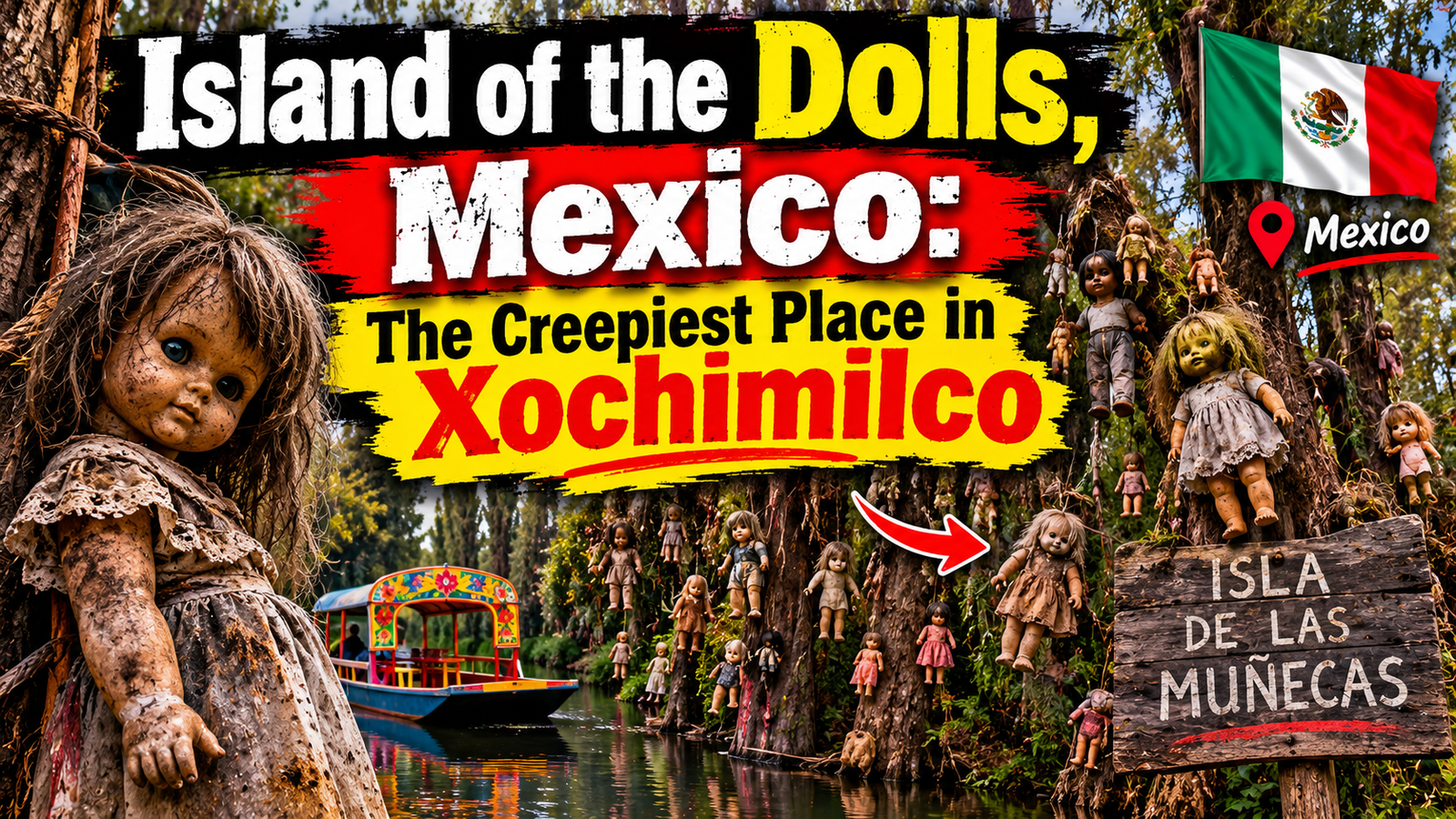
A tiny island where thousands of decaying dolls hang from the trees, and the lonely man who put them there.
Glide along a quiet canal on a flat wooden boat, with the water lapping softly against the hull. Then you turn a corner, and the trees ahead are not quite right. Something pale hangs from every branch. As the boat draws closer, you see them: dolls, hundreds and hundreds of them, with missing eyes, cracked faces, and twisted limbs, all staring out across the water.
This is the Isla de las Muñecas, the Island of the Dolls. It is one of the strangest and most unsettling attractions in Mexico, and its story mixes grief, obsession, and a legend that has never been fully proven.
Where Is the Island of the Dolls?
The island is in Xochimilco, a district in the south of Mexico City. The area is famous for its network of ancient canals and artificial farming islands called chinampas, built by the Aztecs centuries ago. Xochimilco was recognized as a UNESCO World Heritage Site in 1987, and today it is known for its brightly painted boats, called trajineras.
The Island of the Dolls is deep within these canals, away from the busiest areas. Reaching it takes a long boat ride, usually several hours round trip from the main docks.
The Legend of Don Julián
The story begins with a man named Julián Santana Barrera. According to the best-known version, Julián left his family and lived alone on the island for around 50 years, farming and growing vegetables and flowers to sell in nearby markets.
The legend says that, not long after he arrived, a young girl drowned in the canal near his home in mysterious circumstances. Julián was said to have found her body, or to have been haunted by her death. Soon afterward, he found a doll floating in the water. Believing it belonged to the dead girl, he hung it from a tree as a gift, hoping to calm her restless spirit.
But the haunting, he said, did not stop. He claimed to hear a girl’s voice calling out at night, whispers in the dark, and footsteps near his hut. To appease the spirit, he kept collecting dolls and hanging them around the island. He found them in garbage dumps, canals, and by trading vegetables for them. Over the years, the number grew into the thousands.
Why Does It Look So Eerie?
The dolls were never protected. For decades, they have been exposed to sun, rain, humidity, insects, and mold. Their plastic has faded, their paint has peeled, and many have lost their eyes, hair, or limbs. Some are covered in moss and cobwebs. Others are missing heads, and their bodies hang from rusty wire.
This slow decay is what gives the island its disturbing atmosphere. A doll is meant to look like a child’s friend, and a damaged doll looks like a corrupted version of that. Psychologists have long noted that things that look almost human, but not quite, can trigger an uneasy feeling. This reaction is often called the “uncanny valley.”
Visitors also say the dolls seem to whisper, turn their heads, or open and close their eyes. Scientifically, this can be explained by wind moving the dolls, shifting light and shadows, and the human brain’s habit of seeing faces and movement where none exist. It is called pareidolia.
The Mysterious Death of Julián
In April 2001, Julián Santana Barrera was found dead in the same canal where the girl was said to have drowned. His nephew, Anastasio, reportedly found him. For many people, this seemed like the perfect ending to a ghost story: a man haunted by a drowned girl, who died in the exact same place.
After his death, the island stayed popular, and Anastasio continued to care for the site, opening it to visitors.
How Much of the Story Is True?
This is where the legend becomes complicated. Many details come from Julián’s own stories, and from what his relatives have said. Some sources suggest that:
There is no clear record of the drowned girl.
Some family members have described Julián as a man who became deeply isolated and obsessed in his later years.
Over time, tour operators and visitors added more dolls and more spooky details, which helped the island’s fame grow.
It is safest to say that Julián’s life and death are real, that the dolls are real, and that the ghost story comes from his own beliefs. Whether a girl truly died is not confirmed.
Visiting the Island Today
Many travelers include the island on a Xochimilco boat trip. You can hire a trajinera at one of the docks, such as Cuemanco, and negotiate the route and price in advance. The trip is long, so plan a full half-day. A few tips:
Agree on the price and the destination first. Confirm the boat will actually go to the island.
Bring water, sunscreen, and cash. There is little available on the way.
Be respectful. Some visitors leave a new doll as an offering. Do not remove anything.
Visit in daylight. The canals are not lit at night.
Final Verdict: Haunted Island or Folk Art of Grief?
There is no scientific proof that the Island of the Dolls is haunted. But that doesn’t make it any less powerful. At its heart, it is the story of a lonely man who tried to deal with fear and guilt in the only way he knew how.
The island is part memorial, part folk art, part ghost story. It reminds us that the scariest places are often not the ones with real monsters, but the ones where human sorrow and imagination meet.
What do you think? Was Julián haunted by a real spirit, or did grief and loneliness create the legend? Share your thoughts in the comments below.
