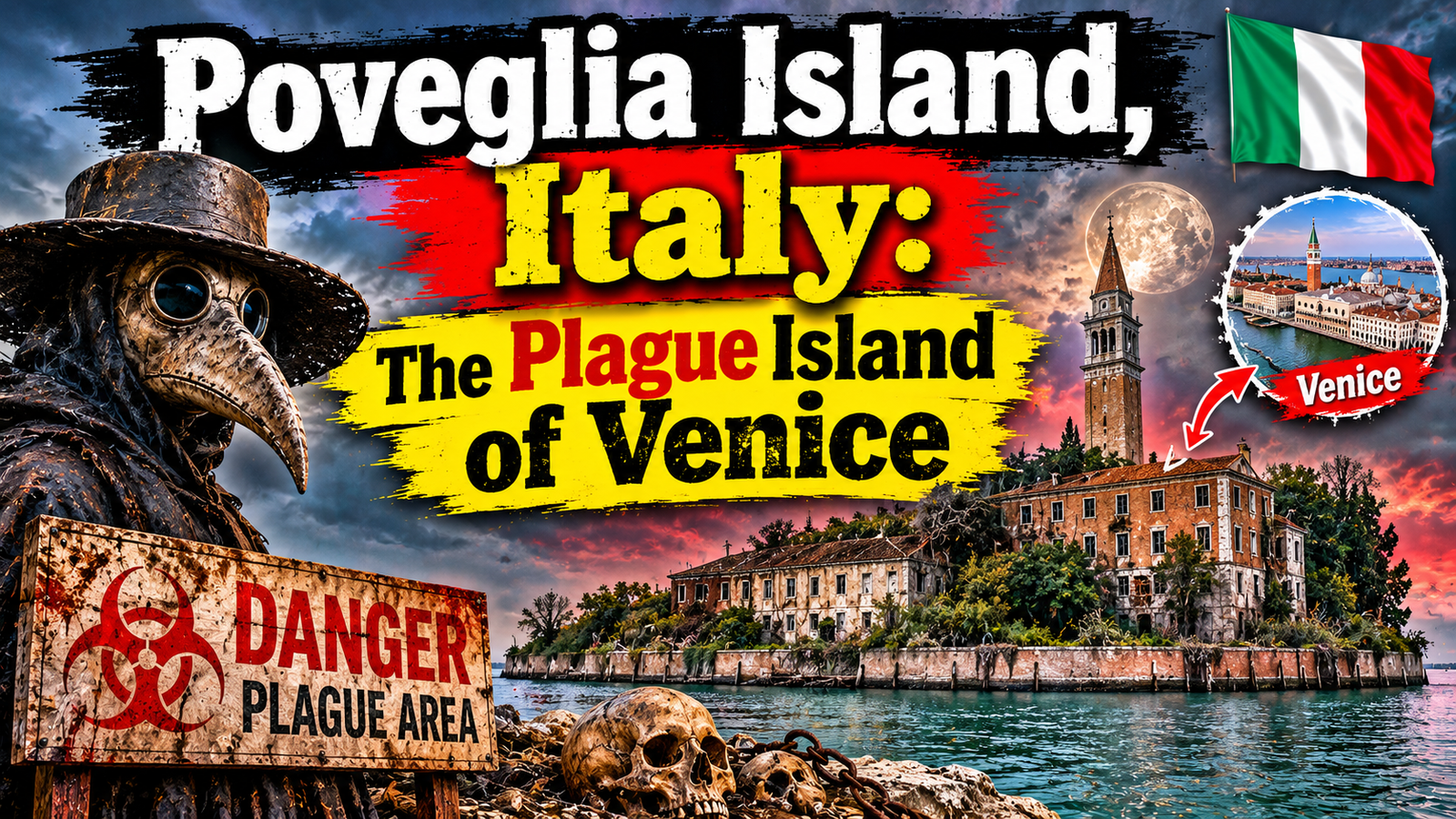
A small, overgrown island in the Venetian Lagoon that many call the most haunted place on Earth.
Venice is one of the most beautiful cities in the world, with golden light on its canals and crowds of visitors on its bridges. Yet just a short boat ride away lies a place almost nobody is allowed to visit. Its brick buildings are swallowed by weeds, its windows are empty, and a lonely bell tower rises above the trees.
This is Poveglia, a tiny island with a dark past. Stories of plague, madness, and restless ghosts have given it a terrifying reputation. But which parts are history, and which parts are legend?
Where Is Poveglia?
Poveglia sits in the Venetian Lagoon, between Venice and the island of Lido. It is small, only a few hectares, and made up of a main island and a smaller section separated by a narrow canal. For centuries it was part of Venice’s system of islands used for defense, storage, and health control.
A Long and Troubled History
Poveglia’s history stretches back well over a thousand years. Records suggest people took refuge there as early as the early Middle Ages, escaping invasions on the mainland. For a time, it had a small community of fishermen and farmers.
Over the centuries, the island took on very different roles. It served as a lookout and defensive post for Venice, and later as a place to store goods. But its most infamous purpose came with disease.
The Plague Island
Venice was one of the great trading ports of Europe, which also made it very vulnerable to epidemics. Ships arrived from across the Mediterranean, and with them came the plague. The Black Death in 1348 and later outbreaks killed huge numbers of people.
To protect the city, Venice created some of the world’s earliest quarantine systems. Ships were held offshore, and the sick were isolated on lagoon islands. Poveglia was used to hold people suspected of having the plague, and many who were sent there did not return. In 1793, it was formally made a quarantine station (lazzaretto) for arriving ships.
The dead were often buried or burned on the island. Over time, this led to the claim that the soil is full of human remains.
How Many Died There?
You will often read that 160,000 people died on Poveglia, or that about half of the island’s soil is made of human ash and bones. These claims are repeated everywhere online. However, there is little reliable evidence for such exact numbers. Historians agree that many plague victims were buried on the island, but the dramatic figures are probably exaggerated. It is safest to say that a very large number of people died there over the centuries, without claiming an exact count.
The Mental Hospital
In 1922, the island’s old buildings were reopened as a psychiatric hospital, and later part of it also served as a home for the elderly. It stayed in use until 1968, when it was closed and abandoned.
The most famous legend concerns a doctor at the hospital. According to the story, he carried out cruel experiments on patients, and eventually went mad, hearing the voices of the dead. He supposedly climbed the bell tower and either jumped or was pushed to his death, with some versions claiming that a mist or a spirit forced him over the edge.
It is a chilling tale, but historians have found no solid evidence that such a doctor existed. Most researchers believe the legend grew from the combination of plague history, the asylum, and the island’s spooky appearance. Mental hospitals of that era were often harsh and poorly regulated, and that reality alone helps explain why the stories feel believable.
Why Is It Said to Be Haunted?
Visitors and paranormal investigators have described a range of experiences:
Whispers and voices when no one is nearby.
Strange shadows moving between the ruined buildings.
A heavy, uneasy feeling that makes some people want to leave.
Reports from local fishermen who reportedly avoid the island and refuse to cast their nets nearby.
There is no scientific proof of ghosts. But the setting is ideal for fear: ruined walls, silence, dim light, and a long, tragic history. Add the power of suggestion, and the mind does the rest.
Why Can’t You Visit?
Poveglia is officially off-limits. Landing without permission is not allowed, and the Italian authorities keep the island closed mainly because its buildings are in poor condition and are unsafe. The government also owns it, and for decades it has had no clear use.
Some people still try to visit, and there are reports of tourists and filmmakers who have gone ashore secretly. This is illegal, and it is dangerous. The old structures can collapse, and boat travel in the lagoon requires care.
The Island for Sale
In 2014, the Italian state put a long-term lease of Poveglia up for auction, hoping to raise money. A businessman, Luigi Brugnaro, won the bid with an offer reported at around €513,000 for a 99-year lease. He planned to develop it, but many Venetians objected. A local group formed to try to keep the island open to the public. Brugnaro later withdrew from the project and went on to become the mayor of Venice. The island remains closed, and its future is still uncertain.
Poveglia in Pop Culture
The island has been featured in paranormal TV shows, documentaries, books, and horror films, which helped turn a local legend into an international one. For many readers, it is now the first name that comes to mind when they hear “haunted island.”
Final Verdict: Ghosts or History?
Poveglia is not proven to be haunted, but it is undeniably a place of real suffering. Plague victims, patients, and ordinary people lived and died there across the centuries. That history deserves respect, not just thrills.
The island stands as a quiet reminder of how fear of disease once shaped cities, and how the spaces left behind can keep telling stories long after the people are gone.
What do you think? Would you dare to spend a night on Poveglia, if you could? Share your thoughts in the comments below.
