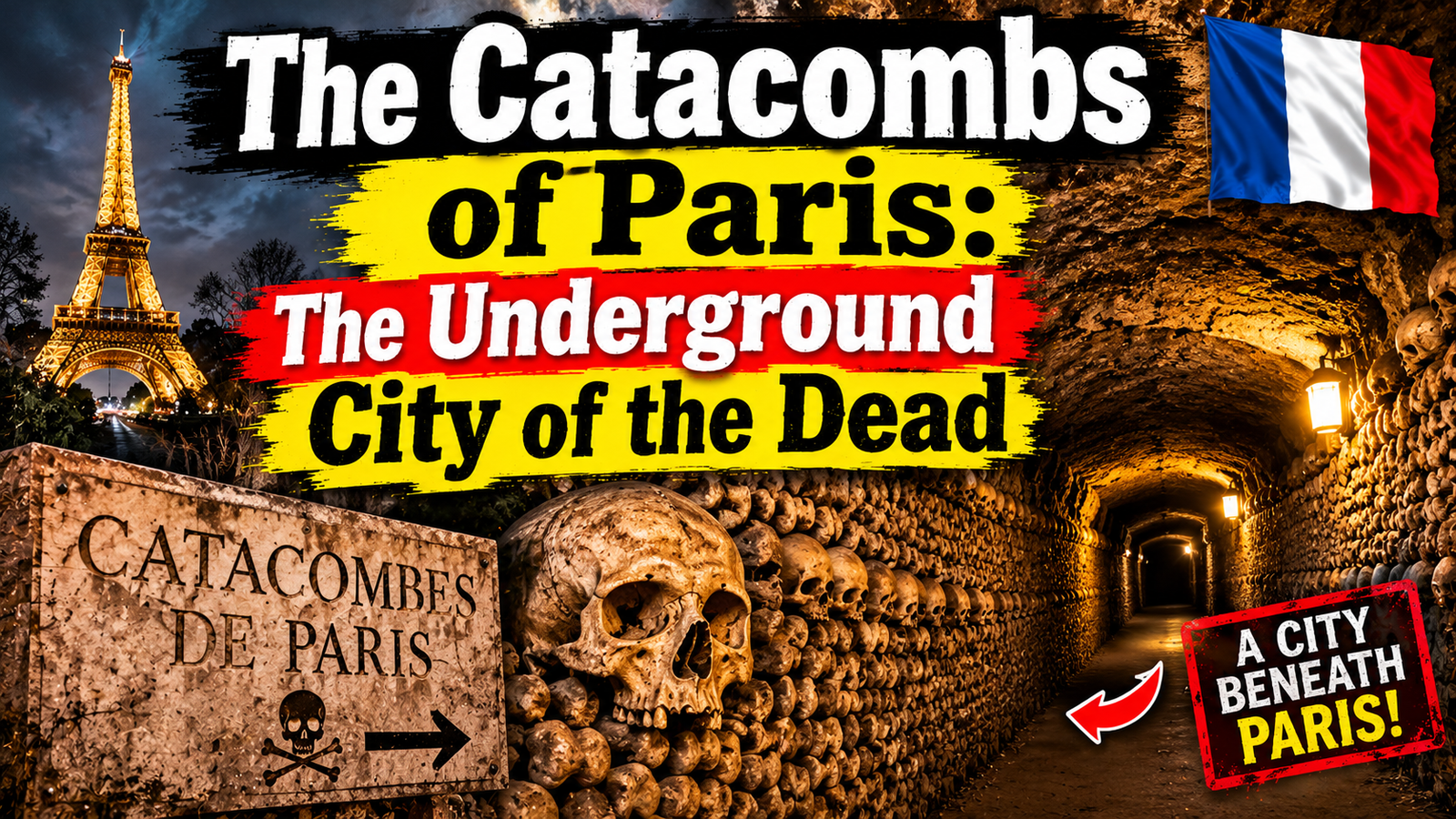
Beneath one of the most romantic cities on Earth lies a maze of tunnels holding the remains of millions of people.
Paris is known for cafés, art, and lights. But about 20 meters beneath the busy streets, the mood changes completely. The air is cool and damp, the tunnels are narrow, and the walls are not made of stone alone. They are built from human bones: skulls and thigh bones stacked neatly in patterns, mile after mile.
Welcome to the Catacombs of Paris, one of the most extraordinary and unsettling places in the world. How did millions of the dead end up under the City of Light?
What Exactly Are the Catacombs?
The name actually covers two different things, and people often mix them up.
The quarry network: A huge system of old underground limestone quarries, estimated to stretch for around 300 kilometers beneath Paris.
The ossuary: A small section of those tunnels, about 1.5 kilometers long, where bones were moved and arranged. This is the part open to the public.
The ossuary is often said to hold the remains of around six million people, though this figure is an estimate.
From Quarries to Tombs
The story starts with stone. For centuries, builders dug limestone from beneath Paris, and that stone was used to build much of the city, including some of its most famous landmarks. The quarrying left a vast hollow network under the streets.
By the 1700s, this created a dangerous problem. Some roads and buildings began to collapse into the empty tunnels beneath them. After a serious cave-in in the 1770s, King Louis XVI’s government created an inspection service to map and reinforce the quarries.
At the same time, Paris faced a very different crisis above ground.
The Overflowing Cemeteries
For about a thousand years, Parisians had been buried in church graveyards in the middle of the city. The largest was the Cimetière des Innocents, in the heart of Paris. As the population grew, graves were reused again and again, and the ground became overloaded with bodies.
The smell was terrible, and people living nearby complained of sickness. In 1780, after heavy rains, a wall of a cellar next to the cemetery collapsed under the pressure of the buried remains, spilling decaying matter into neighboring homes. The authorities decided it was time to act.
They chose a solution that solved two problems at once: empty the cemeteries and fill the empty quarries.
The Great Transfer
Starting in 1786, workers began moving the bones from Paris’s crowded cemeteries into the old quarries. To avoid public alarm, the transfers were done at night. Black-draped carts, accompanied by priests chanting prayers, rolled through the streets carrying bones to the underground site.
This went on for years and continued into the early 1800s. Millions of remains were moved. At first the bones were simply dumped, but later an inspector named Louis-Étienne Héricart de Thury had them arranged more carefully, forming the patterns of skulls and bones that visitors see today. The ossuary was opened to visitors in the early 19th century.
Walking Through the Ossuary
Today’s visitors descend a spiral staircase of about 130 steps, deep into the earth. The tunnels are around 14 °C all year. Above the entrance to the ossuary, an inscription is carved in French, which translates as “Stop! This is the empire of Death.”
Inside, bones are stacked into long walls, with skulls forming decorative rows and shapes, including a heart-shaped design. Plaques with poems and religious texts about life and death hang along the way. It is a strange blend of order and eeriness, and many people find it both fascinating and moving.
Secret Tunnels and the “Cataphiles”
The public section is only a tiny part of the quarry network. The rest has been closed to the public for decades, but it has never been empty. A subculture of urban explorers called cataphiles has explored the forbidden tunnels for generations.
In 2004, Paris police discovered a hidden cavern equipped with a large cinema screen, a bar, and a restaurant, set up by a group of explorers. It was a startling reminder of how much activity can exist out of sight.
Entering the closed tunnels is illegal and dangerous. People have become lost in the maze, and one famous story tells of Philibert Aspairt, a man who got lost in the tunnels in 1793. His body was reportedly found about 11 years later, and he was buried where he was discovered.
The Catacombs in War
The tunnels also played a role in the Second World War. Members of the French Resistance are said to have used parts of the network, while German forces reportedly built a bunker in the tunnels. These stories add yet another layer to the underground world.
Is It Haunted?
With so many remains, it is natural that people connect the catacombs with ghost stories. Visitors report cold spots, whispers, and a heavy feeling in the dark. Yet there is no scientific proof of hauntings. The tunnels are cold and echoing, and the human mind finds patterns and fear in places like this. It is better to treat the ossuary as what it truly is: a resting place for the dead, deserving of respect.
Visiting the Catacombs
The ossuary is open to tourists and is run by the city of Paris. A few useful tips:
Book tickets online in advance. Queues can be very long, and visitor numbers are limited.
Wear comfortable shoes. There are many steps, and the floor can be uneven and damp.
Bring a light jacket. It is cool underground, even in summer.
Not recommended for people with claustrophobia, heart or breathing problems, or limited mobility.
Do not touch or take any bones. It is illegal and disrespectful.
Rules and opening hours change, so check the official website before you go.
Final Verdict: A City of the Dead
The Catacombs of Paris are not a ghost story. They are a real, practical solution to a public health crisis that became one of the most memorable places in Europe. They remind us that even the most beautiful cities are built on layers of history, and that the dead still shape the world of the living.
What do you think? Would you walk through the tunnels lined with millions of bones? Share your thoughts in the comments below.
